

26 January 2026 • 3 min read
When it comes to premium progressive lenses, accuracy is everything. Most professionals emphasize pupillary distance (PD), yet the back vertex distance is equally vital.
These two measurements, often treated independently, actually work together to ensure optimal lens positioning and visual clarity. In the era of digital eyewear sales, understanding and leveraging both BVD and PD has become a necessity, not a luxury.
Understanding the Role of Back Vertex Distance in Eyewear
The back vertex distance is the space between the back surface of a corrective lens and the front of the cornea. This measurement, typically expressed in millimeters, may seem minor, but it can significantly affect the lens's optical performance, especially for high prescriptions or progressive designs.
Why BVD Matters
Any variation in BVD changes the effective power of the lens. In progressive lenses, where the design includes multiple focal zones, this variation can shift the entire viewing corridor. If the BVD is even slightly off, it can cause:
- Blurred vision in one or more zones
- Distortion or swim effects
- Eye strain and headaches
Not Just a High-Prescription Concern
While BVD has traditionally been prioritized in high prescriptions (above +/- 4.00 D), its influence on lens behavior makes it essential for all progressive lens users. A study published in 2024 by Optometry Today showed that more than 68% of patient complaints linked to progressive lenses stemmed from poor fitting parameters, including incorrect BVD.
Why Accurate PD Measurement Alone Is Not Enough
The pupillary distance represents the horizontal spacing between the centers of the pupils. It's a core element in positioning lenses correctly in front of each eye. However, relying solely on PD for lens fitting overlooks the three-dimensional aspect of how lenses interact with a wearer’s facial anatomy.

PD Without BVD: A Two-Dimensional Risk
Think of PD as aligning a lens left and right, while BVD aligns it forward and backward. Without both, alignment is incomplete. An accurate PD might ensure the lens centers are correctly aligned, but if the lens is too close or too far from the eye, the optics are still compromised.
Additionally, PD is typically static, while BVD can fluctuate depending on frame type, face shape, and lens curvature. This makes BVD a dynamic measurement that must be individualized, particularly in online fittings.
Common Pitfalls in Online Fittings
When only PD is considered during online eyewear orders, several issues may arise:
- Incorrect progressive corridor placement
- Misalignment with the wearer’s optical center
- Increased non-adaptation rates for progressive lenses
Recent e-commerce surveys in 2025 reported that return rates for progressive lenses sold online reach up to 25% when BVD is not factored in. This highlights a costly oversight for retailers and manufacturers alike.
How BVD and PD Together Ensure Premium Progressive Lens Performance
To fully optimize the visual experience with progressive lenses, both PD and BVD must be integrated into the fitting process. The relationship between these two variables is foundational to digital lens design software used by manufacturers to compute precise lens geometry.
The Chain Reaction of Small Errors
Even a 2 mm deviation in BVD can alter the perceived power by 0.12 diopters in a +6.00 D lens, a margin enough to degrade vision quality. Add to this an incorrect PD, and visual zones will shift, potentially rendering expensive lenses ineffective.
Practical Illustration
Imagine a patient with a +5.50 D prescription and a 64 mm PD. If the BVD is assumed to be 12 mm during production but the actual fitting results in a BVD of 10 mm, the effective power increases. The result: blurred intermediate vision and compromised near tasks. These misalignments become especially critical in premium lens designs that aim for a personalized experience.
Tech-Enabled Precision
Technologies such as Fittingbox’s PD Measurement tool and Face Shape API play a critical role in improving digital accuracy. These tools help simulate 3D facial positioning and take into account how frames sit on a person’s face, allowing more accurate BVD calculation in real time.
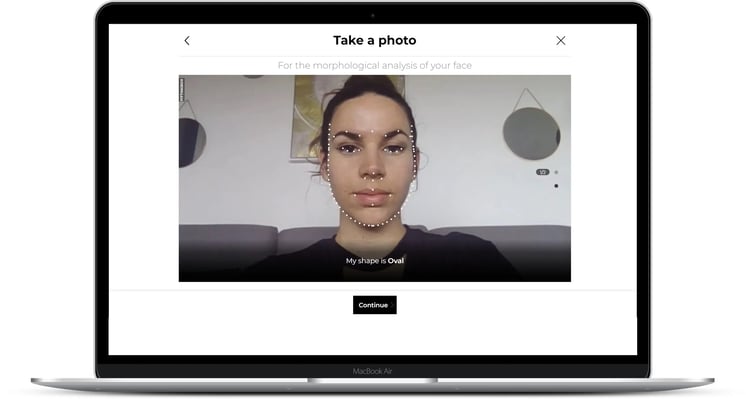
Tools and Best Practices for Online BVD and PD Collection
Capturing both PD and BVD digitally is now achievable thanks to advances in computer vision and augmented reality. For eyewear retailers looking to reduce return rates and improve customer satisfaction, these tools are indispensable.
Essential Tools for Online Eyewear Accuracy
| Tool | Function | Benefit |
|---|---|---|
| PD Measurement | Measures interpupillary distance | Improves optical center alignment |
| Face Shape API | Analyzes face geometry in 3D | Estimates how frames influence BVD |
| Frame Removal | Captures face without obstruction | Ensures accurate data for modeling |
Best Practices for Online Retailers
- Educate users about the importance of both PD and BVD
- Use calibrated tools rather than manual inputs
- Guide customers to position themselves correctly during scans
- Offer try-on simulations that reflect real lens positions
In 2025, eyewear brands that implemented both PD and BVD collection saw a 22% decrease in lens-related complaints and a 15% boost in customer retention, according to industry reports.
Conclusion
The back vertex distance is no longer an advanced fitting parameter reserved for in-store measurements. Alongside pupillary distance, it plays a central role in delivering the promise of premium progressive lenses.
As digital eyewear shopping continues to grow, integrating these measurements into the online journey is essential for precision, comfort, and satisfaction. Leveraging the right tools helps transform what was once a complex clinical measure into a standard for superior online optical experiences.


LET'S TALK
Request a demo, a quote or set up an appointment with one of our sales representatives.
CONTACT US
Useful Links
Corporate
Follow Us
© FITTINGBOX 2026 • Terms of use • Privacy & Legal