

12 January 2026 • 3 min read
Precise lens positioning is essential for delivering clear and comfortable vision. To achieve this, three critical measurements must align perfectly: pupillary distance (PD), ocular center height, and back vertex distance (BVD).
These parameters define how lenses interact with your eyes and influence how well a prescription performs. Whether you're shopping for glasses in-store or online, understanding these metrics helps ensure that your lenses are tailored to your unique visual needs.
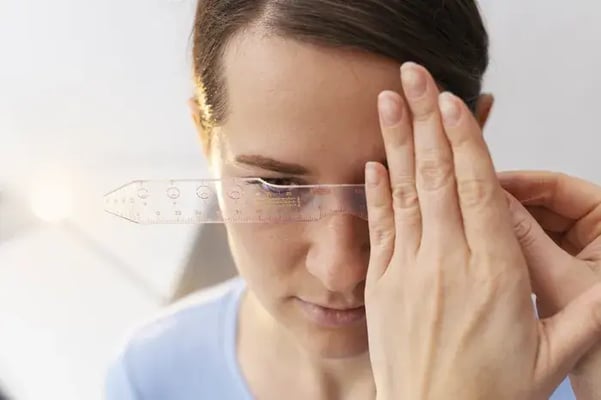
Understanding the Basics: What Are PD, OC Height, and BVD?
Accurate eyewear prescriptions depend on three key optical measurements. Let’s break down what each of them means:
- Pupillary distance (PD): the horizontal distance between the centers of your pupils. This ensures lenses are aligned with your eyes for optimal focus.
- Ocular center height: the vertical distance between the center of your pupil and the bottom of the lens or frame. This is crucial for proper vertical alignment of the optical center.
- Back vertex distance (BVD): the distance between the back surface of your lens and the front of your eye. This affects how the prescribed power is perceived, especially for high prescriptions.
These measurements guide opticians in positioning lenses so the visual axis passes directly through the optical center of each lens. Any deviation can cause distortion, headaches, or reduced visual acuity.
The Role of Ocular Center Height in Visual Accuracy
The ocular center height is often overlooked but plays a central role in ensuring lenses are properly aligned on the vertical axis. While PD ensures horizontal alignment, the OC height defines the vertical positioning.
Depending on the frame style and the shape of a person's face, the center of the pupil may not sit exactly in the middle of the lens. If this vertical offset isn’t accounted for, it can lead to issues such as blurry vision, visual fatigue, or even postural discomfort as the wearer compensates by tilting their head.
To measure ocular center height:
- The person must be wearing the actual frame.
- The measurement is taken from the center of the pupil to the deepest point of the inside of the lens rim.
Many virtual try-on technologies are now capable of estimating this automatically, enhancing the precision of online eyewear fittings.

Back Vertex Distance: Often Overlooked but Crucial
Back vertex distance is particularly important for prescriptions exceeding ±4.00 diopters. Even small changes in BVD can significantly affect the perceived lens power.
A lens prescribed at a specific distance from the eye may deliver too much or too little correction if that distance varies in reality. For example, if a lens meant to sit 12 mm away is positioned at 16 mm, its effective power will shift, potentially impairing vision.
Typical values:
- Average BVD: 12 to 14 mm
- Variation tolerance: ±1 mm for low prescriptions, ±0.5 mm for high prescriptions
Professionals measure this with a distometer, but new digital tools can provide an approximate BVD remotely, making this crucial metric accessible for online prescription verification.
.webp?width=601&height=400&name=docteur-testant-la-vue-du-patient%20(1).webp)
How These Measurements Influence Online Glasses Fitting
Selling prescription glasses online requires reproducing the precision of an in-store fitting. Measurements like PD, ocular center height, and BVD must be obtained or estimated with accuracy to ensure the user receives lenses that work for their unique anatomy.
Here’s how online fitting can succeed with the right tools:
- Pupillary distance measurement can be captured using advanced facial recognition algorithms and smartphone cameras.
- Ocular center height can be deduced through AI-based modeling that factors in frame dimensions and facial proportions.
- BVD can be estimated based on the frame fit and depth parameters collected via virtual fitting solutions.
Technologies like the PD Measurement or the Frame Removal solution by Fittingbox help recreate the conditions of an optician’s fitting room. These tools are key to delivering quality visual correction in a virtual environment.
In fact, as of 2024, over 70% of eyewear e-retailers reported integrating virtual try-on tools to improve accuracy and reduce returns. The adoption rate of automated PD and OC height measurement systems has grown by 48% since 2023, reflecting increased trust in digital fitting technologies.
Conclusion
Understanding and measuring ocular center height, PD, and BVD are not just technicalities, they are essential for delivering accurate vision correction. Whether in-store or online, these parameters determine how well prescription lenses perform.
As eyewear retailers continue to expand their digital offerings, leveraging smart measurement tools becomes critical to ensuring every pair of glasses delivers clear, comfortable, and reliable vision.


LET'S TALK
Request a demo, a quote or set up an appointment with one of our sales representatives.
CONTACT US
Useful Links
Corporate
Follow Us
© FITTINGBOX 2026 • Terms of use • Privacy & Legal