
Pupillary distance, or PD, is the distance between the centers of your pupils, measured in millimeters. It helps ensure that the optical centers of your lenses align correctly with your eyes for clearer and more comfortable vision.

When shopping for glasses online, one measurement often goes unnoticed but plays a critical role in visual comfort: your pupillary distance. Commonly abbreviated as PD, this value represents the space between the centers of your pupils and it’s not just a technical detail.
A correct PD ensures that lenses align precisely with your eyes, offering optimal clarity and reducing eye strain. As more people turn to digital platforms to buy eyewear, knowing your pupillary distance has never been more important.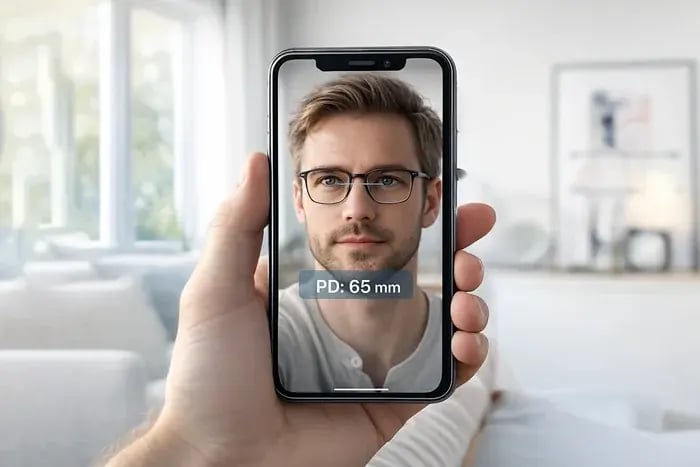
Pupillary distance, or PD, refers to the measurement between the centers of your pupils, expressed in millimeters. It determines where the optical center of your lenses should be placed, ensuring that your eyes look through the correct part of the lens. This alignment is crucial for both visual clarity and comfort.
There are two types of pupillary distance: binocular PD, which is the total distance between both pupils, and monocular PD, which measures the distance from the center of each pupil to the bridge of the nose. The monocular measurement is especially important for people with asymmetrical facial features, as it allows for more precise lens placement.
Pupillary distance varies by age and facial structure. In adults, the average pupillary distance ranges between 54 mm and 74 mm. For children, it is usually between 43 mm and 58 mm. Measuring PD correctly becomes more relevant when prescription strength increases, since the slightest deviation in alignment can affect vision and create discomfort.
In essence, pupillary distance is not just a number, it is a key parameter that opticians and eyewear providers rely on to personalize visual correction. Without it, even the most advanced lenses may not perform as intended.
Accurate pupillary distance is essential for properly aligning prescription lenses with your eyes. When the optical centers of the lenses match your pupils, light passes through the lenses as intended, providing clear and comfortable vision. If the lenses are misaligned, the visual experience can be significantly compromised.
Wearing glasses with an incorrect PD can cause several problems:
These issues often go unnoticed until users report discomfort after switching glasses, especially when purchased online. For high-index lenses or multifocal designs, precision is even more critical. A deviation of just 1 or 2 millimeters in the PD can shift the optical center of the lens, resulting in visual aberrations.
In traditional optical stores, PD is measured by professionals and integrated into the lens crafting process. In online eyewear retail, however, the responsibility often shifts to the consumer. This makes accurate self-measurement or the use of reliable digital tools indispensable to avoid optical errors.

Measuring pupillary distance is a straightforward process, but it requires precision. In a physical optical store, opticians use specialized tools such as a pupillometer or millimeter ruler to capture the measurement. At home, individuals have several methods to obtain their PD accurately.
The most basic method involves using a millimeter ruler and a mirror:
While simple, this method can introduce small errors. It is best performed with assistance or repeated several times for consistency.
Technology has made PD measurement more accessible. Several apps and online platforms now offer tools that use facial recognition or smartphone cameras to calculate pupillary distance. Some require a reference object such as a credit card to calibrate the measurement.
Among the most reliable options are web-based platforms that use real-time camera input and automatic detection. These tools offer an easy and contactless experience, especially helpful for first-time online eyewear shoppers or for those without access to a professional measurement.
The online eyewear market is expanding rapidly, with global sales of eyeglasses and sunglasses expected to exceed USD 210 billion by 2025. As more consumers purchase prescription eyewear online, ensuring accurate pupillary distance has become a top priority. A missing or incorrect PD is one of the main reasons for discomfort or return requests when ordering glasses digitally.
According to a 2024 consumer study, nearly 32 percent of online eyewear returns are linked to issues with PD or lens misalignment. These figures highlight how crucial PD is in delivering a satisfying and precise optical experience.
Virtual try-on experiences, once considered optional, are now standard features on most e-commerce eyewear sites. However, without an accurate pupillary distance, even the most advanced visualization tools fail to reflect true fit and lens functionality. This makes PD measurement a foundational step in the online optical journey.
Retailers and optical brands are integrating technologies that guide users through the PD measurement process before finalizing their orders. Clear instructions, automated tools, and integrated calibration solutions are helping reduce error rates and improve buyer confidence.
.webp?width=700&height=500&name=concept-de-collage-de-reconnaissance-faciale%20(1).webp)
As digital eyewear sales grow, innovation has accelerated to simplify and improve how users measure their pupillary distance. Today’s leading online measurement tools combine real-time camera analysis, artificial intelligence, and automated detection to eliminate guesswork and minimize error.
Modern platforms allow users to measure their PD using only a smartphone or webcam. These systems analyze facial landmarks and iris position to generate precise readings, often in under one minute. Some require a reference object, while others use face dimension estimation to auto-calibrate.
One notable approach is the integration of PD measurement directly into the eyewear selection process. For example, try-on technologies can automatically detect PD as users explore different frames virtually, streamlining the user experience.
E-commerce platforms and optical retailers can now integrate PD measurement features directly into their websites or applications. These APIs provide real-time PD detection, enhancing both convenience and accuracy for online shoppers. By embedding such tools in the purchasing workflow, brands reduce returns and increase customer satisfaction.
Among the most advanced tools available, some include detailed calibration systems, facial scanning, and integration with virtual try-on experiences. These systems not only measure pupillary distance but also provide data that enhances frame fitting and lens customization.
Solutions like the online PD measurement tool available in the optical industry offer a user-friendly and precise alternative to in-store visits. These technologies are transforming the online eyewear journey by bridging the gap between professional accuracy and digital convenience.
Understanding your pupillary distance is more than a technical detail, it’s a fundamental element for ensuring accurate vision correction and comfort when buying glasses online. As digital eyewear shopping continues to rise, knowing how to measure your PD and using reliable tools has become essential.
Whether through manual methods or advanced digital solutions, accurate PD measurement bridges the gap between optical precision and online convenience. Prioritizing this small number can make a big difference in your visual experience.

Pupillary distance, or PD, is the distance between the centers of your pupils, measured in millimeters. It helps ensure that the optical centers of your lenses align correctly with your eyes for clearer and more comfortable vision.
Pupillary distance is important because it helps position prescription lenses correctly in the frame. If the PD is wrong, the optical center of the lens may not align with your eyes, which can cause blurry vision, eye strain, headaches, or discomfort.
You can measure your pupillary distance at home with a millimeter ruler and a mirror, but small errors are possible. A more convenient option is to use an online PD measurement tool that uses a smartphone or webcam to detect your pupils and calculate the measurement automatically.
Binocular PD is the total distance between both pupils. Monocular PD measures the distance from each pupil to the bridge of the nose. Monocular PD can be more precise, especially for people with asymmetrical facial features or stronger prescriptions.
Yes, incorrect pupillary distance can affect vision comfort. If the lenses are not aligned with your pupils, you may experience blurred vision, eye fatigue, headaches, dizziness, or difficulty focusing, especially with stronger prescriptions or multifocal lenses.
Yes, incorrect pupillary distance can affect vision comfort. If the lenses are not aligned with your pupils, you may experience blurred vision, eye fatigue, headaches, dizziness, or difficulty focusing, especially with stronger prescriptions or multifocal lenses.
Request a demo, a quote or set up an appointment with one of our sales representatives.
CONTACT US
© FITTINGBOX 2026 • Terms of use • Privacy & Legal