
27 July 2026 • 6 min read
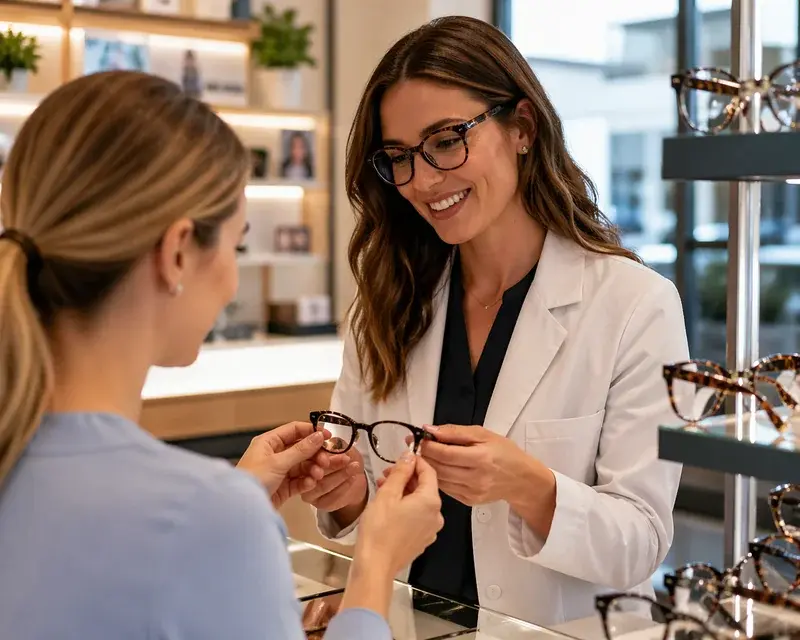
Shoppers hesitate when they cannot predict fit, scale, and style on their own face.
3D glasses technology solves that by combining face tracking with accurate 3D frame assets, so customers can try it on virtually with confidence.

What “3D glasses try-on” really means in eyewear e-commerce
In eyewear, “3D glasses try-on” is often used as a catch-all term. In practice, there are two different experiences that can work together on the product page: a 3D product view (rotate a frame in space) and a face-based try-on (place the frame on a live camera feed).
The business goal is not the wow effect alone. It is to reduce purchase hesitation, raise conversion rate, and limit expectation mismatch that leads to returns.
3D product visualization vs face-based try-on
A 3D product view helps shoppers understand shape, hinge details, and materials. It is great for exploration and merchandising, especially on mobile where a single interactive asset can replace multiple angles.
Face-based try-on is the moment of decision support. It answers “How do I look?” and “Will it fit?” which are the two questions that block checkout for first-time buyers.
Many eyewear teams combine both: a 3D view for discovery, then a realistic try-on for confidence. That combination matches the broader adoption curve of AR shopping, with consumer usage projected to be mainstream by 2025 in the US. (BrandXR, 2025)
Why eyewear needs higher realism than most categories
Glasses sit at the center of the face. Small errors in scale or alignment are immediately visible, and they damage trust. That is why eyewear try-on depends on precise positioning and photorealistic rendering.
Market growth reflects how fast retailers are moving toward more immersive shopping. The virtual try-on market is expected to grow quickly through 2030, with 2024 cited as a step-up year in market size. (Grand View Research, 2024)
The tech stack behind 3D glasses technology
Realistic glasses try-on is a pipeline. It starts with the face, continues with accurate 3D assets, and ends with rendering that looks believable in the shopper’s lighting.
If one layer is weak, the experience feels like a filter, not a shopping tool.
Face tracking and landmark detection
The system detects facial landmarks in real time, typically including eye corners, nose bridge, cheek contours, and head pose. These points let the try-on engine anchor the frame and keep it stable as the user moves.
This is more than a technical detail. Stable tracking reduces friction, keeps shoppers engaged, and supports stronger purchase intention. Academic research on AR shopping platforms links interactivity and vividness with engagement and purchase intent. (ScienceDirect, 2024)
Some retailers also use face-shape classification to improve the browsing experience. A face shape API can power smarter sorting and recommendations so shoppers reach “their” styles faster.
3D frame assets, materials, and scale
Next comes the frame itself. The best results come from true-to-life 3D assets with correct proportions, lens plane geometry, and material definitions. This is where a consistent asset pipeline matters for an eyewear catalog.
Think of 3D frames as reusable content, not a one-time project. Once created, the same asset can support a try-on experience, a 3D product viewer, and marketing visuals.
For scale, retailers often combine multiple cues: known frame dimensions, face landmark distances, and optional measurement tools. An online pupillary distance measurement tool can add an extra layer of reassurance for shoppers who want precision before they buy.
Real-time rendering and lighting
Rendering turns data into believability. To look real, frames need consistent occlusion, correct shadows, and reflections that match the environment. That is why modern try-on engines apply lighting estimation and material shading in real time.
Features like frame removal improve realism by handling hair overlap and partial occlusion, so the frame does not appear pasted onto the face. That realism is a direct conversion lever because it reduces “This will not look like that in real life” doubt.

How the experience works on a product page
From the shopper’s perspective, the technology should feel simple: tap, allow camera access, try it on, switch colors, add to cart.
From your perspective, each step is an opportunity to remove friction and capture measurable signals that connect to revenue.
Camera onboarding and privacy basics
The first seconds matter. A lightweight permission screen with clear value messaging improves activation rate. For example: “See true-to-scale fit and color before checkout.”
Privacy reassurance also improves adoption. Many retailers keep the experience session-based and do not store video, which helps teams align with internal compliance requirements.
Fit cues that reduce hesitation
Try-on is most effective when it answers fit questions without forcing the shopper to become an expert. Helpful cues include:
- Size indicators tied to frame dimensions and face scale.
- Side-by-side comparison between two frames.
- Lens options that show how the final product will look.
A lens simulator can support premium lens upsell by visualizing coatings and tint categories, while reducing confusion that leads to post-delivery disappointment.
Where 3D Viewer fits vs try-on
A 3D viewer is ideal when the goal is product understanding: hinge details, rim thickness, acetate depth, and premium finishing. A try-on is ideal when the goal is self-projection: “Is this me?”
On high-intent product pages, both can contribute. The 3D viewer supports consideration, while the try-on supports decision.
If you want to see how a dedicated module can support this exploration step, a 3D Viewer experience can be deployed as a lightweight, interactive product visual on your PDP.
interactive 3D product viewer for eyewear pages
What to measure: conversion rate, returns, and UX signals
3D glasses technology becomes a business tool when it is measured correctly. The goal is not “usage.” The goal is incremental revenue and fewer costly returns.
Industry reporting in eyewear highlights that shoppers who use try-on are more likely to purchase, and retailers also link try-on to return reduction. (Digital Commerce 360, 2025)
KPIs and event tracking
Start with a simple measurement map that connects try-on usage to funnel performance:
- Try-on activation rate (PDP visitors who start the experience).
- Engaged sessions (time, frame switches, saved looks).
- Add-to-cart rate after try-on vs no try-on.
- Checkout conversion rate lift for try-on users.
- Return rate delta by cohort and by frame category.
Also track “confidence signals” like zoom usage, color changes, and comparing two frames. These are intent indicators that can inform merchandising and retargeting.
A/B test setup that business teams trust
To prove impact, run an A/B test on a defined set of frames and keep everything else stable. Measure conversion rate and return rate by variant, then extend to more of the catalog.
If you need a fast path to production for eyewear try-on, start with a proven website module and expand features once the lift is validated.
website glasses try-on built for conversion goals
Deployment patterns that keep performance and realism high
Most try-on projects succeed or fail on rollout strategy. The winning pattern is to ship a high-quality experience on a meaningful slice of the catalog, measure lift, then scale the asset pipeline.
This aligns with market momentum. Virtual try-on is not slowing down, and 2024 is already cited as a higher market-size year than 2023 in industry forecasting. (Grand View Research, 2024)
Asset pipeline and catalog coverage
Catalog coverage matters because shoppers compare frames. If try-on only works for a handful of SKUs, you create a fragmented experience. A structured 3D asset pipeline, supported by a dedicated 3D studio process and a frame database, helps you scale without quality drift.
Reducing friction with smart features
Two features often improve both realism and speed to purchase:
- Frame removal to handle occlusion and improve trust in what the shopper sees.
- Pupillary distance measurement as a reassurance layer for fit-sensitive buyers.
realistic rendering with frame removal for better confidence
online pupillary distance measurement for fit reassurance
Choosing the right modules for your roadmap
If your priority is conversion rate lift, start with a realistic try-on on your best-selling frames, then add measurement and lens visualization.
If your priority is brand differentiation, combine try-on with rich 3D product interaction and consistent assets across channels.
Either way, treat 3D glasses technology as a performance layer in your ecommerce stack, not a campaign. When it is integrated into the PDP and measured like any other conversion lever, it becomes a reliable growth driver.
glasses try-on strategy for ecommerce performance
Conclusion
3D glasses try-on works when face tracking, accurate 3D assets, and realistic rendering come together in a low-friction product page flow.
For eyewear e-commerce, that realism drives measurable outcomes: higher conversion rate, fewer returns, and stronger customer confidence.

Sources
- Virtual Try-on Market Size, Share And Growth Report (2024) https://www.grandviewresearch.com/industry-analysis/virtual-try-on-market-report
- 2025 Augmented Reality in Retail & E-Commerce Research Report (2025) https://www.brandxr.io/2025-augmented-reality-in-retail-e-commerce-research-report
- How Eyeglasses Retailers Are Using Virtual Try-Ons to Boost Conversion Rates (2025) https://www.digitalcommerce360.com/2025/09/18/how-eyeglasses-retailers-are-using-virtual-try-ons-to-boost-conversion-rates/
- From screen to reality: How AR drives consumer engagement and purchase intention (2024) https://www.sciencedirect.com/science/article/pii/S2773067024000219
- Snap Inc. Integrates AR Digital Try-On Technology: 2.4x purchase intent and 14% sales lift (2024) https://www.perfectcorp.com/business/successstory/Snap-Integrates-Perfect-AR-Digital-Try-On-Technology

LET'S TALK
Request a demo, a quote or set up an appointment with one of our sales representatives.
CONTACT US
Useful Links
Corporate
Follow Us
© FITTINGBOX 2026 • Terms of use • Privacy & Legal