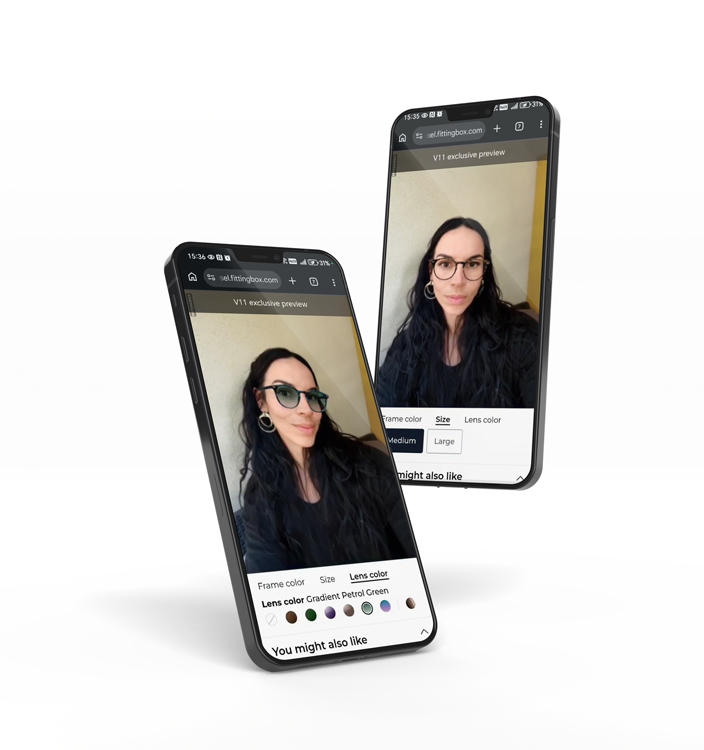
Virtual try-on helps shoppers see how frames look on their own face before buying. This reduces style uncertainty, supports faster decisions, and helps shoppers feel more confident at checkout.
Online eyewear shoppers rarely ask, “Is this frame good?” They ask, “Is this frame me?”
That one question drives hesitation, abandonment, and preventable returns. Here is how virtual try-on experiences for buyer psychology help shoppers decide with confidence and help you protect e-commerce performance.

Eyewear is functional, but it is also identity. Frames sit on the most visible part of the body, show up in every selfie, and shape how others read someone’s personality.
In-store, people resolve style doubt quickly by turning their head, stepping back, and checking multiple angles. Online, they are stuck with a static photo and a mental simulation.
Shoppers are not only picking acetate versus metal. They are choosing “creative,” “professional,” “minimal,” or “bold.” When the product page cannot support that self-image, they delay the purchase.
This is why eyewear carts often die at the last step. The shopper does not want to be wrong, not because of price, but because of social exposure.
Large catalogs can raise engagement and also raise doubt. When every frame seems plausible, the shopper keeps browsing to find the “perfect” option, then closes the tab.
If your PDP cannot help them eliminate options confidently, your “more choice” strategy can quietly hurt conversion rate.
Confidence is not a vague feeling. It is the sum of small questions the shopper must answer before clicking “buy.”
If you can help them answer these questions inside the product page, you reduce hesitation and reduce post-purchase regret, which is a common trigger for returns.
This is about geometry and proportion. Shoppers want to know if the frame balances their features, not just if it looks “nice” on a model.
A glasses virtual try-on experience creates the missing context by showing the frame on the shopper’s own face, at the moment they are most uncertain.
Style-fit is situational. A shopper might want one frame for office days and another for weekend outfits. They need to visualize “me at work” and “me outside.”
When shoppers can switch colors, materials, and silhouettes quickly, they stop imagining and start comparing. That is a major psychological shift, because comparison feels safer than guessing.
Even when shoppers like the style, they worry about realism. Lighting, lens reflections, and the sense of depth are hard to infer from flat photography.
This is where the quality of 3D assets and rendering matters. A smooth experience can feel credible. A low fidelity one can backfire by increasing doubt.
The role of virtual try-on in buyer psychology is simple: reduce uncertainty at the exact moment the shopper is ready to decide.
In practice, that means pairing realism with control. The shopper needs to explore the product and see themselves wearing it, without friction.
A shopper trusts what they can manipulate. That is why interactive product visualization often outperforms passive content.
For frame exploration, an interactive 3D viewer for eyewear products can turn “I am not sure” into “I can see it clearly,” which is a measurable driver of ecommerce performance.
Many shoppers validate style by asking someone else. If they cannot do that easily, they postpone.
The best try it on virtually flows make sharing effortless. A quick snapshot, a short video, or a side-by-side comparison gives shoppers a fast confidence boost, without forcing them into a separate app or a long process.
From a business view, this reduces drop-off, extends time on PDP in a positive way, and increases purchase intent.
This is not only about “cool tech.” It is about controlling three costly outcomes: abandonment, returns, and missed upsell opportunities.
Returns are a massive industry cost. The National Retail Federation projects $849.9B in total retail returns in 2025 and estimates that 19.3% of online sales will be returned. That reality shapes shopper expectations and retailer margins. (NRF, 2025)
Most avoidable eyewear returns come from mismatch between expectation and reality: “It looked different,” “It felt too bold,” or “It did not suit me.”
When you improve confidence before purchase, you reduce the chance of remorse after delivery. That directly supports lower return rates and protects margin.
To further reduce sizing doubt, tools like an online PD measurement tool help shoppers feel reassured about fit and optical comfort, which supports smoother checkout decisions.
Confidence also affects basket size. When shoppers trust the style choice, they are more willing to add lens options, second pairs, or premium upgrades.
If your experience can show lenses credibly, a lens simulator supports upsell with less perceived risk, because the shopper can see the impact, not just read about it.
If you want better ecommerce results, treat confidence like a product feature. Here is a practical way to build it without bloating your pages.
| Shopper barrier | Experience element | Business impact |
|---|---|---|
| “I cannot picture it on me.” | Try on virtually on PDP, fast launch | Higher conversion rate, lower bounce |
| “I need more angles and detail.” | Interactive 3D product viewing | Higher engagement, fewer style returns |
| “I am unsure about fit and comfort.” | Pupillary distance measurement and fit reassurance | Lower hesitation, fewer post-purchase doubts |
| “I do not trust the finish or color.” | High fidelity rendering and clear materials | Higher perceived value, better AOV |
You do not need a long timeline to learn. Track these signals:
Also measure friction. If experience load time is slow or camera permission prompts feel intrusive, you can lose the trust you were trying to build.
Style confidence is the hidden lever behind eyewear conversions. When shoppers can see themselves, control the view, and trust realism, they decide faster and regret less.
Vitrual try-on for buyer psychology is not about adding features. It is about removing doubt in the decision moment, improving conversion rate, and reducing return rates with a smarter ecommerce experience.

Virtual try-on helps shoppers see how frames look on their own face before buying. This reduces style uncertainty, supports faster decisions, and helps shoppers feel more confident at checkout.
Yes. By helping shoppers better understand style, proportions, and visual fit before purchase, virtual try-on can reduce expectation gaps that often lead to post-purchase regret and avoidable returns.
The most important features are realistic rendering, accurate face tracking, smooth mobile performance, and clear product visualization. These elements help shoppers trust what they see and reduce hesitation.
Virtual try-on should be measured like any e-commerce performance tool. Retailers can track engagement, add-to-cart rate, conversion lift, return rate, and lens attachment rate to understand its business impact.
Request a demo, a quote or set up an appointment with one of our sales representatives.
CONTACT US
© FITTINGBOX 2026 • Terms of use • Privacy & Legal